viernes, 9 de enero de 2015

LA FIBRA DE CARBONO SE ABRE PASO EN LA AUTOMOCIÓN 

(31/12/2014)


      Bien es sabido que el uso de composites está en auge y en constante crecimiento en el mundo de la ingeniería de fabricación y de diseño. Dos de las características más importantes y distintivas de estos materiales es que son más ligeros y personalizables. Es precisamente por estas dos características que los materiales compuestos están jugando un papel fundamental en el sector transporte, ya que se necesitan reducir las emisiones de CO2.

      Hay dos objetivos para lograr reducir estas emisiones de CO2; fabricar coches que cumplan los estándares de emisión de la normativa europea (130 g CO2/km en el año 2015 y 95 g CO2/km en el 2020), y cuidar la relación del consumo de carburantes (para gasolina serían 5.6 litros por 100 km y para el caso del diesel 4.9 litros por 100 km, para el 2015).

      Además, diversos estudios afirman que una reducción del 10% en el peso del vehículo se traduce en una mejora en el consumo del 7%. Esta reducción de emisiones se lograría cumpliendo una serie de objetivos a la hora de diseñar y fabricar los automóviles, que serían:

1.      Reducir el peso
2.      Reducir el coste de las materias primas
3.      Aumentar el volumen de producción, reduciendo los tiempos de ciclo
4.      Aumentar la eficiencia del combustible
  
     El uso de composites reforzados con fibra de carbono en el sector automovilístico podría considerarse aún bajo, pero se prevé que experimente un fuerte y  notorio crecimiento de aquí al año 2020, ya que la fibra de carbono además de ser más ligera que el aluminio y el titanio, es un material de alto módulo elástico que se puede utilizar de una manera versátil para fines constructivos.

      En la actualidad, ya hay algunos ejemplos del papel que están tomando los composites en el mundo del automóvil:

       BMW i3: El compartimento de los pasajeros está fabricado con plásticos reforzados con fibra de carbono (CFRP). Su diseño está especialmente ideado para conseguir una construcción más ligera y para aumentar la seguridad de los ocupantes del vehículo.


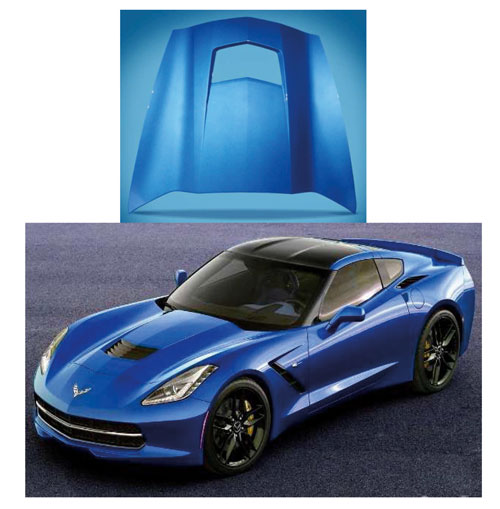
      Chevrolet Corvette Stingray 2014: su capó está fabricado con fibra de carbono mediante procesos de fabricación secundarios, lo que se traduce en una reducción del 5% en peso y una reducción del 7% en costes directos del proceso.


foto
  

      Teijin 4 plazas Concept Car: Su estructura está fabricada con plásticos reforzados con fibra de carbono (CFRP) impregnados con termoplásticos (PP, PA) y se ha conseguido mediante el sistema de fabricación de prensado, logrando un ahorro en el peso del vehículo (47kg chasis + habitáculo) y altos volúmenes de producción.

      La fabricación con CFRP es aún limitada debido a su precio, pero el sector automovilístico ya se está abriendo paso y está introduciéndolos en sus producciones en serie. Esto tendrá un impacto relevante y muy positivo en las emisiones de CO2 y el consumo de energía, aunque para lograr una completa introducción se deberán superar otros grandes retos:

  1. Reducir el coste de la fibra de carbono.
  2. Optimizar y automatizar los procesos de fabricación para aumentar la capacidad de producción reduciendo los costes del proceso.
  3. Dar a conocer aún más los composites y sus características.
  4. Investigar sobre su reciclabilidad.
  5. Involucrar a toda la cadena del proceso: materias primas, transformadores, empresas de bienes de equipo, ingenierías especializadas en automatización, moldistas...)

Si se consiguen cumplimentar todos estos objetivos, los CFRP se convertirán sin duda en la solución predilecta de los fabricantes de automóviles para conseguir cumplir con los requisitos establecidos por la normativa europea medioambiental. 
 Fuentes:
 Interempresas; Emagazine de Plásticos ( http://www.interempresas.net/Plastico/Articulos/  )


MarkForged Announces Cloud Based Software for Mark One, Carbon Fiber 3D Printer

The team at MarkForged is responsible for a carbon fiber 3D printer and a 3D printing carbon material that together are equally impressive. They allow you to 3D print parts that are stronger. They allow you to 3D print parts faster. They allow you to 3D print with power. And now–they allow you to do so from the cloud.
As the ‘unveilings’ begin at 2015 International CES, MarkForged is front and center, letting their present and future client base know that an already amazing 3D printer now has an added feature for teamwork and convenience, as they roll out their cloud-based software for the Mark One Composite 3D printer.


On display at 2015 International CES today, the Mark One is a 3D printer created by a team of inspired engineers who have been working toward the goal of taking what originally seemed like an impossible concept to a reality for many years, pitching in to bring a comprehensive idea full circle and into motion with both machinery and material.
One word that seems to emerge repeatedly with the Mark One is power. And it’s obvious that the power of MarkForged’s product is a direct result of the power of their team.  With the level of teamwork and collaboration present at MarkForged, an open, cloud-based environment for the 3D printer is a logical accessory. This is a group of creators who each had a part in designing a concept and building a product they believed in and were invested in. These are inventors who have made a machine for inventors.
Cloud-based software is an extension to promote and continue teamwork and collaboration not only for the group at MarkForged, but for all the teams who are busy using the Mark One to 3D print carbon products – some of which may have the potential to change the world. It’s an easy connection to make: a powerful team making a powerful product needs a powerful tool.
Made for individuals who have a specific idea and part in mind that they want to design and actually use, the Mark One prints in carbon fiber, offering lighter weight but greater strength, even than metal. Not only that, you can 3D print carbon parts on your desk, designing a part, 3D printing it, and putting it right to use. The capability to print with strands of carbon fiber allows for strength and innovation that supply the potential for designers in many industries to create products we have not even thought of — from aviation, to automotive and motorcycle parts, to prosthetics, robotics, parts for space — and far more.

While the idea of building a powerful new material and a powerful new desktop 3D printer was being conceptualized and designed for years at MarkForged, cloud computing is a concept that has been ‘up there’ for half a century, also conceptualized and in the works until it could be brought to fruition. Now, with many other technological advances all coming together at lightning speed, companies such as this are able to complete and accentuate their products with cloud-based software.
                             
Fuente: http://3dprint.com/35404/markforged-cloud-software


jueves, 8 de enero de 2015

LA IMPRESIÓN 3D DE  MATERIALES MÚLTIPLES CONTINÚA AVANZANDO: INYECCIÓN MÚLTIPLE (10/10/2014)


       Los avances que se están llevando a cabo en tecnología de fabricación aditiva en la actualidad son tantos y tan continuos, que hoy en día ya se pueden fabricar compuestos de varios materiales diferentes de una sola vez, o incluso mezclar gotas de materiales diferentes para crear otros nuevos en la propia impresión.
       Es el caso de las impresoras 3D de triple inyección (para materiales múltiples) de tecnología Polyjet (propiedad de Stratasys).
       Existen dos opciones, la Objet500 Connex1 y la Objet500 Connect2. 
     La primera permite a los usuarios crear conjuntos de tres materiales diferentes para producir componentes en diferentes colores, y que combinen materiales rígidos con otros flexibles, mediante inyección triple, con una recarga de cartuchos que facilita la producción continua de piezas con una menor atención.
      La segunda es una mejora de la anterior, pudiendo realizar todas sus funciones, y además pudiendo crear materiales nuevos (ABS Digital) mediante mezcla de gotas de materiales independientes.

        El resultado es la introducción de compuestos de materiales en asociación con la fabricación aditiva, manteniendo una gran flexibilidad de geometrías, materiales, colores y características a la hora de obtener piezas, todo ello con acabados superficiales muy buenos, manteniendo la mirada en combinar cada vez más materiales diferentes en una sola máquina, en menos tiempo, a mayores tamaños, y sin sacrificar precisión y calidad en ello.


Fuentes:
   Interempresas, Emagazine Plásticos 
        http://www.interempresas.net/Plastico/Articulos/128119-La-impresion-3D-de-materiales-multiples-continua-   avanzando.html
    http://www.stratasys.com

miércoles, 7 de enero de 2015

MIT, Autodesk & Stratasys are Working With ‘Secret’ Materials to Develop New 4D Printing Applications (19/12/2014)


3D printed materials shapeshift over time (Photo: Dan Raviv, Scientific Reports)

    3D printing has come a long way since its inception in 1984. Today, we can print amazing things — from toys on home desktop 3D printers to replacement parts for hardware to advanced prostheses to living tissue. The array of materials available for printing is also widening, from standard plastic resins to chocolates to DNA. The next step for 3D printing, it seems, is to move into the next dimension.

    4D printing adds time to the length, width, and height of the objects we’re already growing accustomed to seeing via additive manufacturing. With the addition of time (a stimulus), objects can become adaptable, changing structures: self-evolving structures, as researchers recently called them.

    Led by Dr. Dan Raviv, a mathematician, researchers prepared “Active Printed Materials for Complex Self-Evolving Deformations,” which was published yesterday, December 18th, in Scientific Reports. The team, comprised of members from MIT, Stratasys, and Autodesk, includes authors Dan Raviv, Wei Zhao, Carri McKnelly, Athina Papadopoulou, Achuta Kadambi, Boxin Shi, Shai Hirsch, Daniel Dikovsky, Michael Zyracki, Carlos Olguin, Ramesh Raskar, and Skylar Tibbits. Dr. Raviv is a postdoctoral fellow in the MIT Media Lab, where he works in the Camera Culture Groupproviding new tools for geometric data analysis.

    The paper the researchers prepared covers their deep look into 4D printing, in which “a new design of complex self-evolving structures… vary over time due to environmental interaction.” Their new approach to additive manufacturing ensures not only that the material changes structure over time, but does so precisely, transforming “into a predetermined shape, changing property and function after fabrication.”

    And the implications are huge. 3D printed objects are already making headlines in industries from biomedical engineering to aerospace (with some literally out-of-this-world projects underway), and 4D printing has untold potential in broad applications from home appliances to medical implants.

“The most exciting part is the numerous applications that can emerge from this work. This is not just a cool project or an interesting solution, but something that can change the lives of many,” Raviv said to Live Science. “In the future, we imagine a wide range of applications.”

srep07422-f4

    4D printed objects respond to stimuli in their environments — adaptive additive manufacturing —  which can lead to promising applications in appliances that respond to temperature conditions, or outerwear that senses the external environment and can keep wearers warmer or drier, or humidity- or temperature-reactive products for childcare. The implications of such products could lead to untold improvement in some qualities of life including via internal implants.

“Today, researchers are printing biocompatible parts to be implanted in our body,” Raviv said. “We can now generate structures that will change shape and functionality without external intervention.” The dream there is to create pieces that will endure: “We want to print parts that can survive a lifetime inside the body if necessary,” noted Raviv.

    To date, the researchers’ impressive efforts have utilized two different materials to create 3D printed structures showcasing various properties. The water-absorbent material they used — with a formula developed by Stratasys that they’re keeping secret for now — could, when immersed in water, double in volume. The other remained in a rigid state, as it was constructed of a stiff plastic. So far, they’ve created a 15 x 15 inch square grid that, with the water-absorbent material, can produce complex geometrical shapes.

    This progress is promising, and they’ve laid the groundwork for this process to expand — and contract. “For things that go inside the body,” Raviv noted, “we want to go 10 to 100 times smaller. For home appliances, we want to go 10 times larger.” Rome wasn’t built in a day, and neither will 4D printing suddenly emerge as a complete game-changer. For now, the test materials eventually wear out after several dozen wet-dry cycles involving shape changes, and lose their shape changing abilities. Additionally, water is the primary stimulus being studied so far, and ultimately materials that respond to other stimuli — such as light and heat — will be a goal of development.

    Check out some more figures from the researchers’ paper below. Let us know what you think about the future of 4D printing in the Self-Evolving 4D Printed Objects forum thread over at 3DPB.com.

srep07422-f2

http://3dprint.com/32127/4d-printing-adaptive-mfg/

Laser cutting replaces water jet at UK metal fabricator (12/12/2014)

        Hessay, York, North Yorkshire, England - Yorkshire Profiles, a metal fabrication and industrial cutting company in the north of the UK, have changed from water jet cutting to a completely laser-based process as of August 2014. This is a sign of the growing industrial investment in laser cutting technology on both a local and national scale, with the Yorkshire based company having clients both in the county and across the country.

        Since founding in 2001, the company has slowly seen the improved accuracy, efficiency and quality of cuts offered by laser cutting in comparison to the often unreliable and limited nature of water jet. Now, with the addition of the Amada F-1 CO2 laser cutting system  to their machinery, the company has been able to further reduce costs to clients and compete on a mass production scale.

        The Amada F-1 has provided a number of invaluable features to the production process. The twin adaptive optics have meant that the often lengthy process of changing lenses for a number of different material thicknesses has been made a thing of the past. Likewise, the automatic nozzles ensure a much lower cleaning time for the machinery, and the lower energy usage has allowed for lower running costs. All this has contributed to the company’s ability to offer 24/7 production, with a much quicker and more precise production.

       Over the past year, the water jet system began to hinder production times, preventing the company not only from progressing, but also from completing their current tasks to the high standards for which they are known. When the company was first founded, they were plagued with operational difficulty with the maintenance of their water jet, and the downtime involved with the nozzle and pump.


       While admittedly, the water jet provided Yorkshire Profiles with the ability to cut thicker materials, the client base had little demand for fabrication of thicker materials, instead preferring the lower costs and efficiency offered by the laser cutting. These factors led to Yorkshire Profiles finally replacing the Water Jet, in favor of following the increased potential profits and client base offered with the laser technology. Selling this system will help to raise funds to further improve their metal folding, fabricating and cutting parts production.

          The company is also in process of installing a fiber laser cutter, further improving productivity and energy efficiency. With a reported energy reduction of 30-40% in this year alone, they’re not only providing a superior quality product, but reducing their environmental impact too.

This article was written by Rachel Jensen on behalf of Yorkshire Profiles.

http://www.industrial-lasers.com/articles/2014/12/laser-cutting-replaces-water-jet-at-uk-metal-fabricator.html